
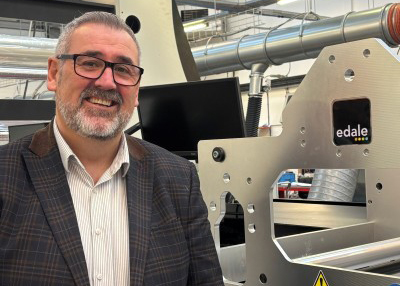
Lachlan Buirds, MD at Edale, explores the hidden production impact of sustainable packaging
WHEN it comes to sustainability in packaging, it is increasingly decided long before a pack reaches the shelf. Brand targets and on-pack claims only capture part of the challenge. The more difficult task is turning those ambitions into reliable production, particularly as converters manage shorter runs, rising SKU counts and a broader mix of solutions.
In many packaging applications, pack performance is closely tied to product protection and shelf impact. A brand can ask for improved recyclability or a shift in structure, but the converter still has to make that decision work on press across a wider range of substrates, shorter run lengths and an increasingly complex mix of SKUs, while accommodating cost and efficiency constraints.
When the material is less predictable, the job will take longer to settle. If a coating behaves differently at speed, affecting ink lay, drying curve or web tension, the level of waste will increase. Substrate variation can also introduce instability in web handling, particularly with thinner films or paper-based alternatives, where maintaining consistent tension becomes more challenging.
This is where the conversations around material transition must become more grounded in production reality. The industry can no longer treat recyclability requirements as a market message. They must be engineered into the way packaging is produced.
Pressure in the pressroom
Recent research reflects the same challenge. McKinsey’s 2025 work on sustainable packaging identified affordability and operational performance as barriers to broader adoption of more sustainable materials. The issue is not material availability, but whether a better material exists and whether that material can be run at the right speed, quality and cost. This shifts the focus from material selection to production capability.
That is primarily a pressroom question. The challenge is no longer just automation or speed, it’s adaptability. Converters must maintain performance as materials, formats and regulatory requirements evolve, without repeatedly re-engineering their processes.
A move from a rigid format to a flexible pouch might reduce material use but it also alters the print and converting requirement. Replacing a traditional laminate with a recyclable alternative can support end-of-life goals, while still meeting product protection and shelf requirements. The benefit depends on delivering it without added production waste.
PackUK’s 2025 recyclability assessment requirements confirm that RAM ratings will be used to modulate household packaging waste disposal fees for the 2026 to 2027 assessment year, directly linking recyclability to cost. That makes production efficiency both a compliance issue and a commercial one. This ties recyclability performance directly to financial outcomes, increasing the commercial risk of inefficient production.
Additional complexity is passed further along the supply chain. Adding a new substrate could end up placing very different demands on tension control, drying performance and registration accuracy. A coating introduced to support recyclability may need a press configuration that legacy equipment cannot easily deliver.
The key question is whether sustainable packaging can be converted consistently, efficiently, and at commercial scale.
Converters don’t just need flexibility, they need production platforms that can actively accommodate change. With substrates, coatings and applications in constant flux, press performance must remain stable across a wide operating window without repeated process resets, requalification, or loss of efficiency. Running varied materials and applications with minimal intervention.
Waste reduction must also be achievable in practice. Lowering makeready waste only delivers value when it is supported by control and consistency. Automation can help bring the press into register and impression faster, reducing manual intervention. The greater requirement is maintaining consistent performance across changing conditions.
Single-pass production can also cut out unnecessary handling between processes, limiting the points where loss occurs.
The converters best prepared will be those able to make new materials behave predictably in live production. That means moving between substrates, formats and SKU demands without disrupting throughput or building avoidable waste into the process.
Increasingly, production investment is being judged on how well it protects against future change, not just how it performs today.
As brand owners face greater pressure to improve recyclability, converters will need to provide the production confidence behind those claims. In practice, the success of sustainable packaging will depend not only on what materials are selected, but on how reliably, efficiently and economically they can be converted.