
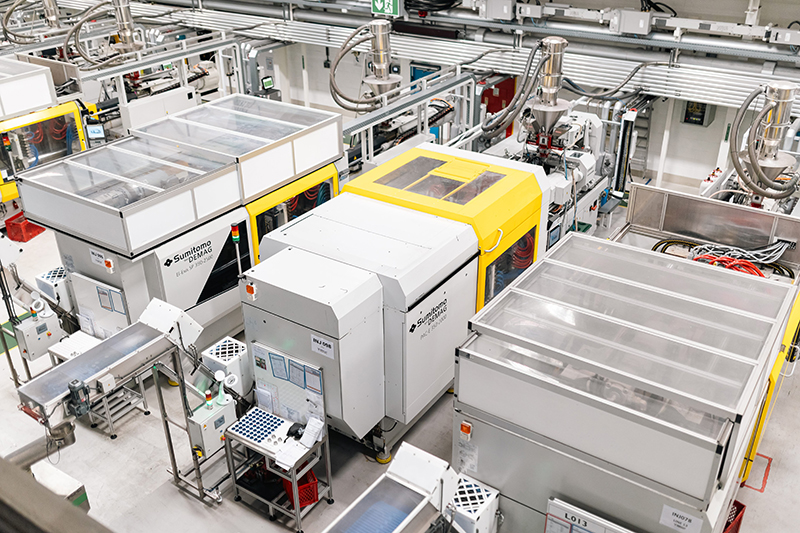
BERICAP UK and Sumitomo (SHI) Demag have highlighted energy savings of over 50% following an 18-month development project testing every performance aspect of the latest PAC-E machine in a real production setting.
The two organisations collaborated to test the PAC-E for caps and closures using high-pressure production conditions. This approach demonstrated the advantages of integrating operational insights from end-users throughout the development process.
“With razor-thin margins, processing speed is everything in the packaging industry,” said Bruce Margetts of Bericap UK. “We never imagined all-electric could meet our performance demands until the PAC-E machine proved otherwise.
“Utilising our high-demand production environment as the proving ground, Sumitomo (SHI) Demag delivered on their productivity promise, giving us the competitive edge to take our business even further.”
After observing the performance advantages and energy efficiencies throughout an 18-month testing period, Bericap UK placed an order for a serial production 350-ton PAC-E.
Already conceptualised with input from Sumitomo in Japan and the German product engineers, the PAC-E development faced one major industry challenge. This new machine would have to demonstrate and convince packaging manufacturers that it could match the previously ‘unparalleled’ performance of Sumitomo (SHI) Demag’s El-Exis SP series, but deliver the environmental, cleanliness and efficiency benefits of an all-electric system.
Bericap UK in Hull provided the demanding production environment to validate and optimise the machine’s capabilities. Accommodating a 350-ton PAC-E in active production over 18 months, the machine ran over 11 million cycles. This enabled the Sumitomo (SHI) Demag engineering team to fine-tune cycle speeds, improve component resilience, and reduce energy consumption in cap production by over 50%, all while delivering on Bericap’s live commercial orders.
“In fact, the machine was running continuously and proving to be so energy efficient and reliable, it was challenging to persuade the production team to switch it off to make adjustments,” added Bericap UK process engineer Dean Bramley.
For the duration of the project, engineers, process managers, directors and technical specialists from both companies hosted regular on-site reviews, bi-weekly development meetings, and weekly technical calls. This feedback loop allowed PAC-E to evolve through live production insights rather than lab-based testing.
Dave Raine, Sumitomo (SHI) Demag’s UK & Ireland MD, commented, “With Bericap’s demanding production environment, we were able to analyse hundreds of application datasets, engage with mould makers and ultimately refine the machine to meet the precise production and user safety requirements.”
The all-electric direct drives designed by Japanese parent company Sumitomo Electric served as a springboard to initiate faster machine developments for sectors traditionally served by hydraulic and hybrid machines, Dave Raine added.
Production parameters such as cycle time stability, dosing consistency, and thermal loading on the drives and spindles were some of the focus areas. By the end of the testing programme, the collaborative team had generated all the data required to prove that PAC-E consistently achieved speeds and energy savings once considered ‘unattainable’ with all-electric injection moulding.
Sumitomo (SHI) Demag engineer Aaron Driver added, “Cycle time, energy consumption and machine uptime are the biggest variables in ROI, so they became our core development priorities. By zeroing in on these performance indicators and continuously refining every element that influenced them, we were able to break through innovation limitations.”
Towards the end of the testing programme, a full injection profile linearity study was conducted by Bericap UK. This helped distinguish the differences between the El-Exis and PAC-E. One of the key highlights drew attention to the re-engineered motion system optimised for short-stroke, high-precision applications. Although the maximum injection speed is lower (550 mm/s vs. 1000 mm/s), the dynamics are described as ‘significantly higher’. The result is sub-two-second cycle times, fast enough to support production of over one billion caps per year on machines running 24/7.