
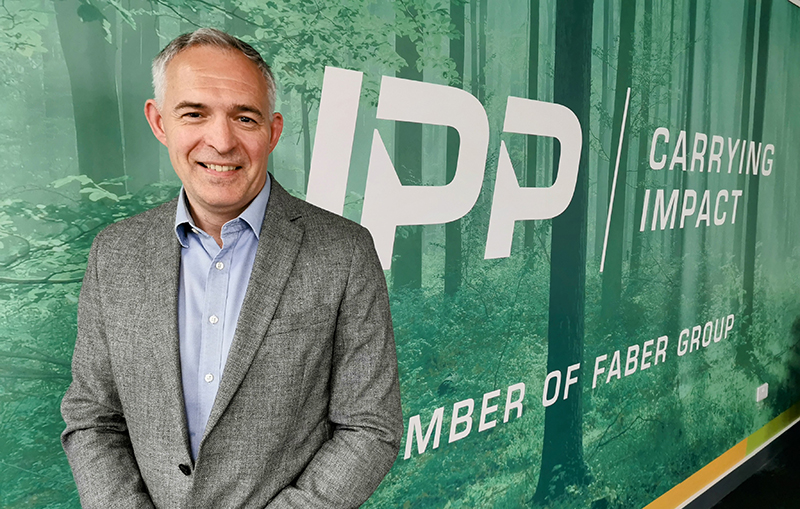
Andy Maddock, IPP UK&I regional MD, explains why ‘going with the flow’ helps business to harness and predict an unpredictable world
GEOPOLITICAL tensions are a constant reminder of the fact that supply chains are only as strong as their weakest links.
The escalating war in the Middle East and the ongoing military conflict in Ukraine prove the point that widespread disruption not only costs countless lives, but also dramatically impacts economies having to react to violent change rather than proactively rolling with the predicted punches.
The consequential closure of the Strait of Hormuz, the sea gateway between Iran and Oman through which one-fifth of the world’s oil supplies reaches the west, has hit pump prices hard. This in turn will inevitably impact global consumer spending, but it could be argued that unpredictability is often the only predictable element of a world on fire.
Change is not only a result of conflict and war, but also the collateral damage of the politics of peace, a hard lesson learned over the last few years as a result of the geopolitical fallout of Brexit. It’s why harnessing change and expecting the unexpected needs to become a hygiene factor for global businesses.
However, there is evidence that business isn’t entirely getting the message. At the receiving end of the supply chain, a comprehensive survey of European manufacturing firms conducted by international customs experts Customs Support Group revealed one in three companies are still predominantly reactive in dealing with global shocks, while 10% remain largely passive and dependent on external support. Only 18% of companies reported an active, forward-looking approach proactively planning for trade and regulatory disruption.
Taking a similarly reactive approach to the availability of our sustainable wooden pallets across European supply chains is not a risk we can take. Predicting the right level of repaired and repatriated pallets required for customers – in the right place, at the right time, at the right cost – is critical to competitiveness, whatever the geopolitical weather.
But performance is defined by more than availability and delivery alone, and businesses must forever operate in a constantly changing world. It’s about anticipation of change and the business continuity that flows from those scenarios. We have to be across the detail and be able to understand it all – or to paraphrase the former US Secretary of State Donald Rumsfeld, we have to recognise the known knowns, the unknown knowns and hopefully predict the unknown unknowns.
To aid this knowledge, robust and resilient logistics must depend upon reliable and relevant intelligence – the predictive partnership planning that strengthens every link in the supply chain.
To this end, our new Intelligent Flow concept reflects how IPP supports supply chains in this context, bringing greater clarity to how partnership, anticipation and continuity contribute to resilient and efficient operations over time.
By managing complexity in the background and working closely with customers, IPP helps supply chains remain reliable and efficient, even as conditions evolve.
The new platform serves as an up-to-date digital hub and a central touchpoint for engagement and communication across the supply chain. It brings together IPP’s pooling solutions, circular systems, digital capabilities and sector expertise, providing a structured way to explore how partnership supports daily operations across industries and markets.
Change is the only constant keeping business leaders awake at night and getting them out of bed in the morning. It is not to be feared, but managed through intelligence, so that whatever the circumstance or situation, we can ensure our supply chains become less fragile and more agile.