
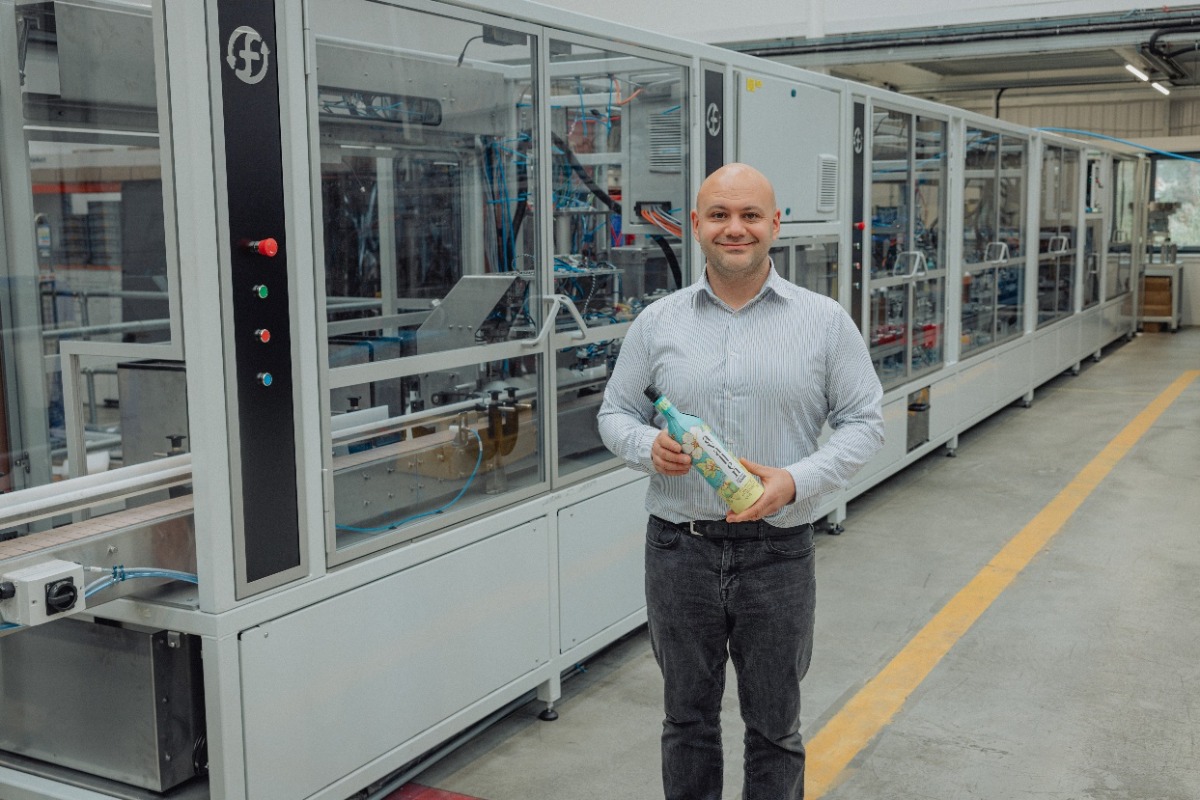
FRUGALPAC has unveiled a new high-speed machine that is said to dramatically increase the production of its paper Frugal Bottles.
The new Frugal Bottle Assembly Machine 2 (FBAM-2) is a scalable platform capable of producing 14 million paper bottles a year – more than five times the capacity of its predecessor, FBAM-1.
Designed for installation at bottling plants and packaging facilities worldwide, the FBAM-2 allows partners to manufacture Frugal Bottles at scale, closer to filling lines, reducing cost, carbon and supply chain risk. Its flexible multi-lane options allow for both smaller and significantly larger production volumes.
Frugalpac, a King’s Award-winning cleantech company based in Suffolk, launched the Frugal Bottle in 2020. It is made from 100% recycled paperboard and has a carbon footprint up to 84% lower than a standard glass bottle.
With the FBAM-2, the Frugal Bottle is now said to be up to 30% lower cost than the current paper bottles, bringing it to price parity – or better – than a labelled glass bottle.
J.P. Grogan, product director at Frugalpac, said, “The FBAM-2 is the industrial rollout the mass market has been waiting for. We have engineered it for maximum uptime and modular flexibility, allowing it to handle everything from spirits and wine to oils and ready-to-drink (RTD) cocktails. The technology is ready; the era of heavy glass is over.”
Malcolm Waugh, CEO of Frugalpac, added, “For decades, glass has been the default for wine and spirits. But it’s heavy, energy-intensive and increasingly expensive to use and recycle. What’s changed is that packaging is no longer just a design choice, it’s a climate decision. Glass is no longer neutral. The FBAM-2 gives the industry a practical way to move faster; cutting carbon, reducing costs and producing bottles closer to where drinks are made and sold. The opportunity is clear. The technology is ready. The future of packaging is lighter and of a lower cost and the industry now has the tools to get there.”