
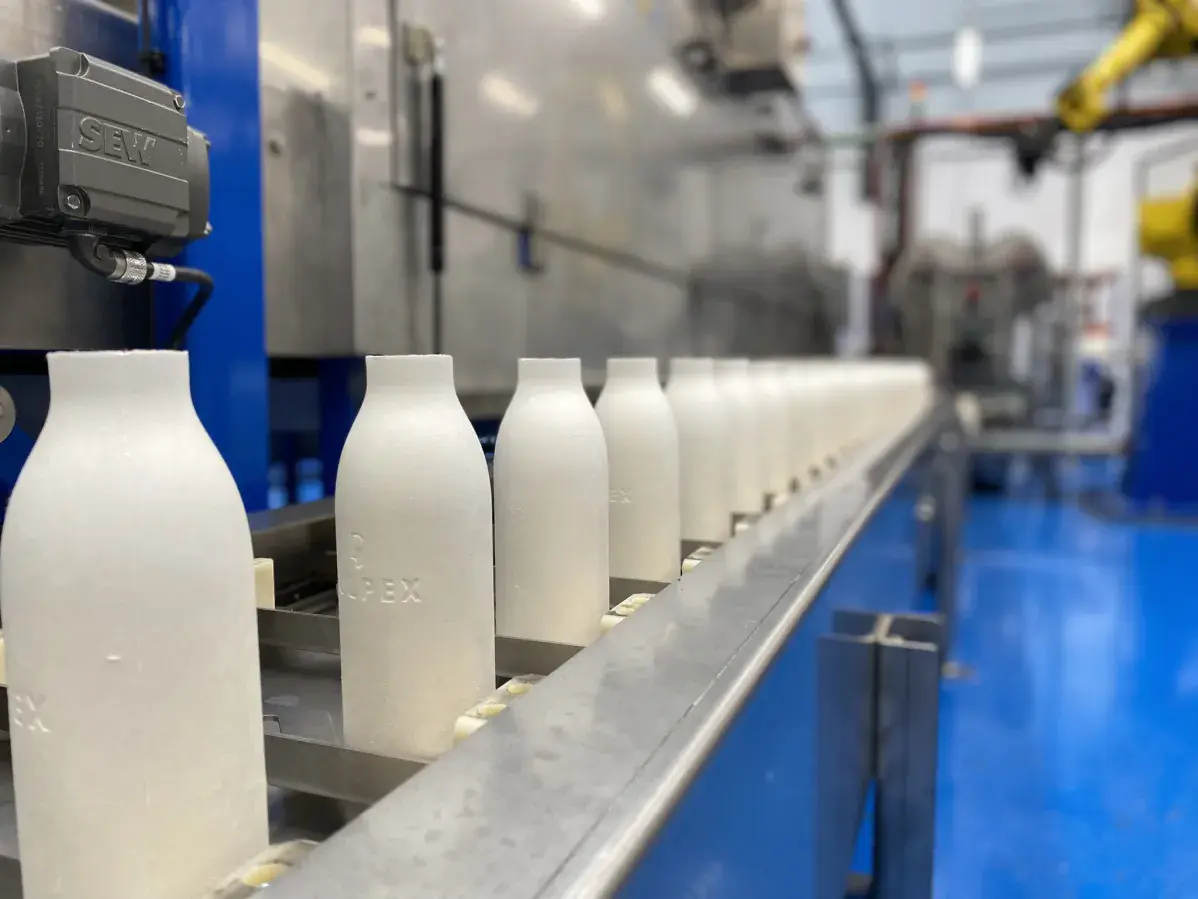
PULPEX, the UK packaging technology company behind an innovative fibre bottle, has opened its first commercial manufacturing facility near Glasgow.
Fitted for an initial capacity of up to 40 million units per annum and creating approximately 39 skilled manufacturing jobs, the plant is the first step on a roadmap to one billion units a year and the working reference model for Pulpex’s global Manufacture Under Licence network.
Pulpex’s patent-protected fibre bottle platform is made from sustainably sourced woodpulp, is free from hidden plastic, and is designed to be recycled through normal household paper and card streams using existing paper and board recycling facilities. Independent of any new infrastructure, the bottle returns through the system consumers already use.
The company explained that such compatibility is a ‘decisive advantage’ for brand owners responding to tightening packaging and recyclability requirements – including those arising under the EU Packaging and Packaging Waste Regulation (PPWR) and the UK’s Extended Producer Responsibility regime.
The bottle is engineered for compatibility with existing filling infrastructure, allowing adoption without costly production-line modifications, while direct-to-shape decoration delivers genuine brand differentiation on shelf.
Ease of adoption extends upstream into the supply chain. Pulpex bottles are produced from non-specialist commodity pulp sourced through established global markets rather than a proprietary or single-source feedstock, removing one of the common barriers to industrialising a new packaging format.
Pulpex also supplies licensed manufacturers with the full validated supply chain of consumables required for production, so partners adopt a qualified and tested system rather than assembling and proving one themselves. The result is a renewable, recyclable, lower-carbon format that can be adopted without compromising product performance, manufacturing efficiency or brand identity, it explained.
Pulpex said the opening confirms that fibre bottle technology has moved beyond pilot and development phases into industrial reality. For brand owners, investors, manufacturing partners, and policymakers, Glasgow provides a tangible platform for the next generation of renewable packaging and a demonstration that a lower-carbon alternative to glass and plastic can be produced at commercial scale, to commercial standards, it added.
The Glasgow site opens with commercial demand already in place. More than 90% of the site’s initial available capacity for the current financial year has been sold, with customers committed across both food-grade and non-food categories.
Purely Scottish Natural Mineral Water will be among the first brands to take commercial volumes from the site, launching what is set to be the UK’s first natural mineral water in a paper bottle following an 18-month collaboration with Pulpex. Smol, the fast-growing household cleaning brand, is introducing Pulpex fibre bottles into the liquid laundry category providing an alternative to conventional plastic packaging in a sector that has historically struggled to move beyond plastic dependence.
The Glasgow site has been engineered as the reference facility for Pulpex’s international expansion. Combined with an active pipeline of brand opportunities, it demonstrates how licensed manufacturing can be deployed globally while UK leadership in technology development and intellectual property is maintained. The route to one billion units is a licensing-led scale-up strategy, built by transferring the Glasgow model to established packaging converters rather than requiring brand owners to become manufacturers.
Sandy Westwater, Pulpex chief executive officer, said, “The opening of our Glasgow facility marks the moment Pulpex moves from proving the technology to proving the industrial model. We have developed and industrialised a breakthrough packaging technology in the United Kingdom, and Glasgow is where partners and brand owners can now see it running. Every Manufacture Under Licence conversation we have from today is a conversation about a working plant rather than a prototype enabling the start of a material impact on our environment by reducing CO2 emissions and critically, removing plastic waste on land and in our oceans.”
The development has been supported by investment from the UK’s National Wealth Fund and the Scottish National Investment Bank.