


MANUFACTURERS are becoming more familiar with the benefits of robotics, automation, digital twins, and industrial software – but there still work to do to help understand what is possible and how to implement them at scale.
That’s the view of Alex Richards, Schneider Electric’s VP of industrial process and automation for the UK and Ireland.
Alex told Packaging Scotland that manufacturers are under increasing pressure to improve productivity and throughput while managing skills shortages, energy costs, sustainability targets, and growing production complexity. Changing consumer behaviour is also driving greater product variation, shorter product lifecycles, and more frequent changeovers.
“Robotics, automation, and digital twins can help manufacturers respond by optimising not just individual machines, but entire production lines and processes,” he explained. “Digital twins, for example, allow manufacturers to model and simulate machines, processes, or plants before making physical changes. This can help teams identify bottlenecks, test operating scenarios, and validate potential performance improvements before making changes to live production.
“When combined with automation, robotics and software, these technologies provide greater visibility and create opportunities to improve efficiency, reduce downtime, and make better use of energy and resources.”
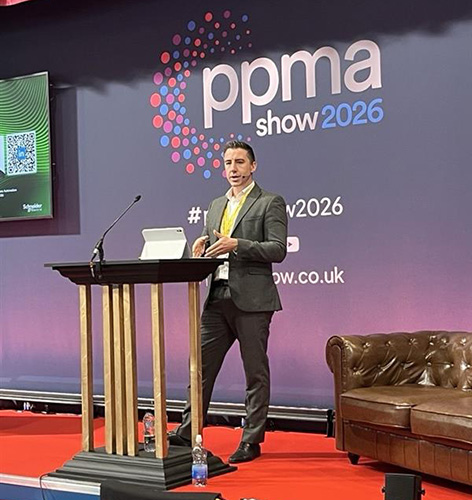
Alex was on the Schneider Electric stand at PPMA 2026, discussing these technologies with attendees. He reckons awareness is increasing and there is an opportunity now to broaden the conversation beyond individual machines and applications.
“We need to look at how these technologies work together across the production line, plant, and wider enterprise,” he added. “By connecting automation, software and data, manufacturers can gain a much clearer view of how their operations are performing and identify opportunities for optimisation.
“The conversation needs to focus on tangible outcomes such as increased throughput, improved efficiency, resilience, and sustainability.”
Alex revealed that while the UK has strong automation expertise and a growing appetite for robotics, there remains ‘significant headroom’ compared with leading manufacturing economies in robotics adoption.
“The technology is now available to integrate software, robotics and automation and demonstrate clear benefits around efficiency, throughput and sustainability. That makes the investment case increasingly compelling. To accelerate adoption, manufacturers need to understand not just what the technology does, but how it can address a specific operational challenge and deliver measurable value. Continued investment in skills, digital infrastructure and practical implementation will also be important.”
A key area of focus for Schneider Electric is Software-Defined Automation. Alex explained it is about decoupling hardware from software, giving manufacturers greater flexibility in how they design and evolve automation systems while making engineering applications more reusable across the lifecycle.
He draws parallels with the music industry, which moved beyond physical formats such as CDs towards separating the content from the hardware.
“Digital twin technology is another important area, at both machine and plant level,” he stated. “We are also supporting customers through Digital Transformation consulting, helping them understand their current readiness, identify areas for development, and create practical strategies to scale digitisation. That digital foundation is increasingly important as manufacturers move from experimenting with AI towards deploying it operationally.”
The firm is also bringing together power and process across energy management, industrial automation, and the digital backbone through EcoStruxure, providing manufacturers with a more integrated approach.
In Scotland, Alex sees a ‘major opportunity’ for the company, both through its direct business and system integrator alliance partners.
“Scotland has a strong industrial base, and manufacturers are looking at how technology can help improve productivity, efficiency, resilience, and sustainability,” Alex concluded. “Rising energy costs and the pressure to reduce waste are also making energy and resource optimisation increasingly important. We see significant scope to support that journey and expand our activity north of the border.”