
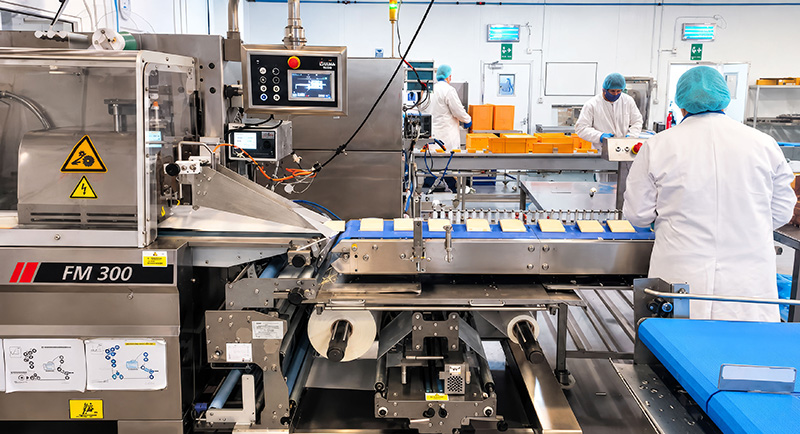
CHEESE specialist Eurilait has reportedly increased machine uptime and reduced waste after standardising its flow-wrapping operation with four ULMA Packaging FM305C machines.
The investment has also added capacity for seasonal demand and co-packing growth.
Eurilait cuts and packs cheeses for retailers and third-party customers, handling around 300 live SKUs across hard, soft and mould-ripened products. Demand increases in the run-up to Christmas, making dependable seals, accurate pack sizes, and consistent presentation essential.
Previously, Eurilait operated flow wrappers from four different manufacturers, requiring operators to understand several control systems and engineers to maintain a larger, more varied stock of spare parts. The business now operates four ULMA FM305Cs, allowing employees trained on one machine to transfer their skills across all four and engineers to support each line using a common stock of spare parts.
The machines typically run at around 55 packs per minute. Although capable of higher speeds, ULMA explained that Eurilait has selected this operating rate to maintain product consistency, achieve the required oxygen and carbon dioxide levels, and ensure reliable seals and a premium pack appearance. The available headroom gives the company scope to increase output when required.
Automated cutting processes feed cheese directly to the flow wrappers, with automatic case labelling incorporated at the end of the lines.
Jamie McCabe, head of operations at Eurilait, said, “Working with ULMA has made our operation much simpler. Our operators only need to understand one machine, and those skills are transferable across all four. Our engineering team knows that one phone call will get the support it needs, while the reliability and spare capacity of the machines give us the confidence to grow.”
The FM305Cs are also supporting Eurilait as it explores more sustainable packaging options. The company is trialling a range of recyclable films, although the long shelf-life required by some cheese products means each trial can take more than 100 days to complete. These materials have yet to move into live production, but the machines’ flexibility provides a platform to test future film structures in collaboration with ULMA’s technical team.