

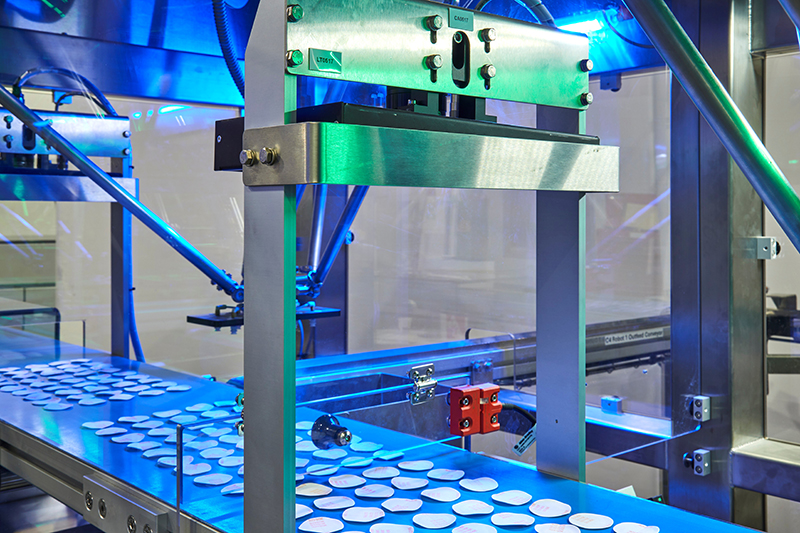
TEKPAK Automation has revealed how it helped a UK pharmaceutical manufacturer of transdermal patches increase production throughput by over 30% thanks to a robotic packaging system.
Incorporating four Schneider Delta robots, the Tekpak QC-Sleever inspects, verifies, picks and packages patches at the client’s site at speeds of up to 1,600 patches a minute, whilst reducing the reject rate to less than 1%.
Tekpak explained it has enabled the customer to cut labour costs considerably, thanks to a reduction of 12 operators per shift – as well as saving them over 30% in total footprint compared to a traditional multi-machine system.
Transdermal patches are medical adhesive strips applied to the skin for uses such as pain management, hormone therapy and smoking cessation. When asked to devise an automated solution for faster inspection and packaging, Tekpak’s team of innovators came up with the Quad Cell (QC)-Sleever.
The solution comprises four main vision inspection stations. Two are located before the quad cell itself, integrated into the upstream patch manufacturing system. While one checks for the shape of the patch, the quality of the solution, and the presence of woven material and any foreign material, the other inspects for the presence of the heat seal on the patches. This data is sent to the four downstream Delta robots inside the quad cell. The cell tracks defects from these vision systems and ensures the robots leave any defective patches on the main infeed belt, eventually ending up in the reject bin.
The other two inspection stations are housed within the quad cell itself. The first scans the position of the patches on the conveyor, reads the alpha-numeric data on the top of the patch, and verifies it is of the correct batch. This data is again sent to the Delta robots, which either pick their allocated patches or leave the rejects on the conveyor to continue to a reject bin. Each robot handles 400 patches per minute.
Once the patches have been picked, they undergo final inspection. The robot presents the underside of the patches to a specialised UV-backlit camera for inspection of a number of metrics, including the concentricity of the patch contents relevant to the patch, the presence of any foreign material, the roundness of the patch, and the position of the gripper head on the patch.
Once the final vision inspection has been completed, the patches are either dropped into another reject bin or placed onto an outfeed conveyor by one of the robots. These conveyors bring the verified patches to the packing/sleeving section of the machine where they are counted and collated into groups of 30. The sleeving section opens the pillow-shaped sleeve, into which a leaflet and the patches are dispensed, before it is sealed using hot-melt glue and printed with the relevant batch data. Finally, the sleeve is verified before being conveyed down to a case-loading robot.
Delta robot technology is again employed in the case packing area. Groups of 10 sleeves are accumulated before a robot picks the group using a gripper head. The group of sleeves are placed into a corrugated case, which is tilted to allow the robot greater access. This is done using a pneumatic tilting device that also tilts back down to allow the insertion of layer cards between the layers of sleeves.
Darragh Sinnott, Tekpak’s technical director, said, “The patches are made up of multiple layers and various materials. The bottom layer is a paper-like material. On top of this is a woven mesh that is then encased in a wet solution which is poured over the pair, before the patch is sealed using a heat press.
“The quality of the patch is inspected upstream by two of our vision systems. This quality control was one of the client’s major requirements; in fact, each patch is subject to ten separate vision inspection jobs at a rate of 1,600 patches p/m before it is deemed to have met the required standards to be packed.”