
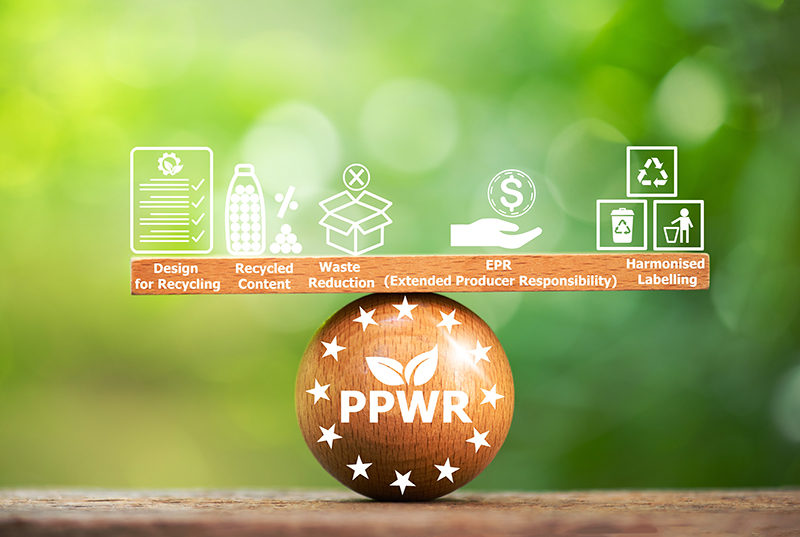
THE EU Packaging and Packaging Waste Regulation (PPWR), which is tipped to transform the packaging landscape, comes into effect from today. The legislation covers packaging across the supply chain, setting goals to reduce waste and increase recycled content.
Compliance specialist Valpak has welcomed the move, while highlighting that many businesses still have more to do to meet their obligations.
Lucy Dolan, operations manager for global compliance at Valpak, said, “From the date of implementation in August, PPWR takes immediate effect. This means that each packaging unit produced after that date must hold a Declaration of Conformity (DOC) and technical documentation evidencing compliance with applicable sustainability requirements in order to trade legally in the European Union or Northern Ireland.
“Valpak has seen a phenomenal number of queries leading up to the deadline – over 100 each week. Many are SMEs but, whatever the size of business, the challenge is the same. Every business is looking for advice on what they need to do, and when they need to do it. We are also seeing confusion around packaging produced before 12 August, which does not fall under the new demand for a DOC.”
Under the new rules, food-contact packaging must comply with strict thresholds of perluoroalkyl and polyfluoroalkyl substances, while heavy metals must be under the thresholds outlined in the PPWR for all packaging. However, any packaging placed on the market before 12 August 2026 can still be sold.
Lucy Dolan added, “The demands are challenging – especially for those brands with multiple product lines – but not impossible. As with other areas of compliance, it is all about sourcing, managing and storing the evidence and data effectively.”
Recycled cartonboard producer, RDM Group, has welcomed the changes and hopes that PPWR will drive smarter use of the resources already available. Krzysztof Krajewski, chief sustainability and innovation officer, says that where high-quality recycled fibre can deliver similar performance, it should be prioritised over virgin material, extending the life of valuable fibres and reducing demand for new natural resources.
“The implementation of PPWR is a landmark moment for Europe’s packaging industry and an important step towards a more resource-efficient, circular economy,” he stated. “The regulation rightly challenges businesses to eliminate unnecessary packaging and improve recyclability, but as brands adapt, there is a risk that packaging minimisation becomes the dominant measure of sustainability simply because it is one of the easiest metrics to quantify.
“Lightweighting has an important role to play, but the lightest package is not always the lowest-impact package. If reducing weight means increasing reliance on virgin raw materials, we’re simply shifting the environmental burden elsewhere. Virgin (or primary) raw materials are inheritably more weight efficient due to their initial strength and mechanical rigidity, so at first glance might appear as the logical selection for lightweight structural designs. However, if extensively used, this would paradoxically lead to increased waste generation.
“PPWR, is by its very name about packaging and packaging waste, and its objectives need to be considered through the wider waste hierarchy. Any lightweighting therefore must ultimately be balanced with reuse and recycling. Recycled cartonboard may result in a heavier pack, but it reduces reliance on primary fibre and keeps existing resources in circulation. The same fibres can be used again and again – as many as 25 times or more – spreading their environmental impact across multiple lives. A slightly heavier pack made with recycled content can therefore represent a more resource-efficient choice than a lighter pack made predominantly from virgin material.”
Stora Enso highlighted that one of the most important first steps in PPWR compliance is to determine the legal role that each business performs in relation to each packaging flow. Terms such as manufacturer, supplier, importer, distributor and producer have specific meanings under the PPWR and do not necessarily correspond to the terminology businesses use in their ordinary commercial relationships.
Erkam Narinç, senior policy and regulatory affairs manager at Stora Enso, said, “Getting the legal role allocation right is fundamental. In particular, the legal manufacturer is not always the company that physically produces the packaging. Incorrect assumptions can create compliance gaps, unnecessary duplication and confusion over who is responsible for the documentation needed to demonstrate conformity.
“The practical priority should be to map packaging flows, assign the relevant legal roles and establish reliable information channels across the value chain. Suppliers need to provide the information required to support compliance, while statutory manufacturers remain responsible for demonstrating the conformity of the packaging they place on the market.
“12 August is the starting point rather than the end of PPWR implementation. Businesses that establish clear responsibilities and information flows now will be much better positioned for the more demanding requirements that follow towards 2030.”
Richard Price, CTO and co-founder, Pragmatic Semiconductor, described the new regulation as an ‘important step’. He said designing with sustainability in mind is vital, but it’s important to consider the whole lifecycle.
“Achieving these ambitions at scale will require the right technology to support them,” he added. “The use of smart packaging to deliver consumer engagement, product authentication and compliance for regulations such as Digital Product Passports creates a new challenge. Embedded technical components must meet immediate requirements and future, more stringent, milestones without slowing the pace of innovation.
“Flexible electronics have a low carbon footprint and digitally connect physical packaging to information about its composition, use and lifecycle. This helps businesses to improve traceability and reuse while giving consumers the information they need to make informed choices around recycling and disposal. By building sustainability into the packaging itself, flexible electronics offer the opportunity for materials to be tracked, reused and recovered throughout their lifecycle.”
Holmen, a specialist in paperboard and paper products made using fresh fibre, revealed it is ready to support customers in navigating the new requirements and preparing their packaging portfolios for the future.
“Material choice has become increasingly important as the regulatory landscape evolves,” said Andreas Boo, head of sustainability and regulatory affairs at Holmen Board and Paper. “Our ambition is to help customers understand how the requirements may affect their packaging and to support them with solutions that are fit for the future.
“The question is not whether PPWR will affect your packaging – but how. The companies that start reviewing their packaging now will be in a much stronger position as requirements become clearer. This will create a smoother transition towards future compliance.”
Packaging Scotland published a commentary piece yesterday by Horst Bittermann, director general of Pro Carton, in which he argues that PPWR marks a significant step towards a more circular packaging economy in Europe.