
FANUC has revealed that automation systems incorporating robotics are becoming an increasingly common sight in food factories around the UK.
The manufacturer explained that robots are ideal for repetitive or laborious tasks such as packing, picking, placing and palletising – leaving the valuable human workforce to concentrate on the parts of production where they can make a real difference.
One company reaping the benefits of automation is Gü Indulgent Foods. Since its first chocolate soufflé pots were launched in 2003, the firm has been on an upward trajectory. As demand soared, Gü needed to expand its packing hall at its facility in Bishops Stortford, Hertfordshire. It turned to FANUC partner Tekpak Automation, based in Wexford, for an automated solution.
“Gü requested a second packing line that needed to fit into a very compact area,” said Darragh Sinnott, technical director for Tekpak Automation. “They also wanted greater cartoning and palletising flexibility. This new line needed to handle Gü’s new quad-packs – the quad-pack x4 – as well as the existing variety of case formats: twin-packs x6 and twin-packs x4.”
With the help of FANUC’s virtual programming software, ROBOGUIDE, Tekpak determined the exact robot models – paying attention to requirements for payload, speed and reach – that would alleviate Gü’s production capacity constraints.
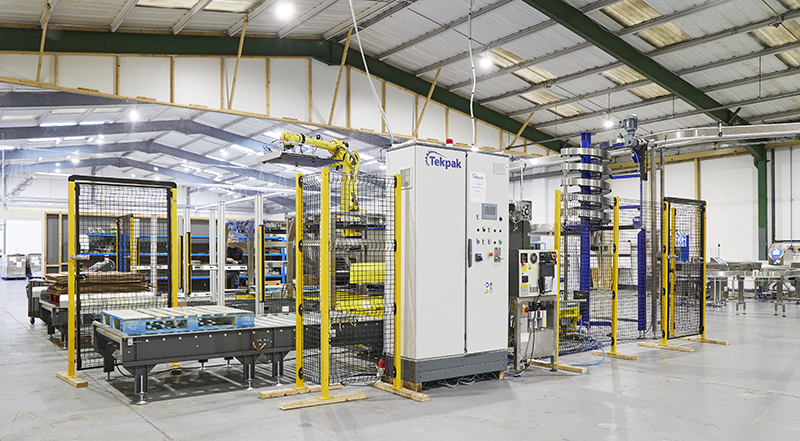
“The end-to-end packaging line we installed begins at the depalletising stage,” added Darragh. “Gü’s filled glass ramekins are skimmed off two pallets, one layer at a time, onto a pair of receiving conveyors. One FANUC R-2000iC/165F six-axis robot handles this job, and also removes the layer card that separates each layer.
“The pallets are supported and indexed up by two industrial-grade scissor lifts fitted with FANUC servo motors that feed the depalletising robot, ensuring a seamless depalletising process.”
The Tekpak system then collates the ramekins, loads them into cartons with integrated laser printing, and case packs with subsequent case labelling, before the final palletising process begins. Again, a FANUC R-2000iC/165F six-axis industrial robot is employed here.
Andrzej Rosa, head of engineering for Gü Indulgent Foods, said, “The new packing line has given us greater flexibility and increased our production capacity. The FANUC robots are quick, robust and reliable and are a proving a valuable addition to our operation.”
Power Food Technology, based in Co. Kildare, is a specialist system integrator providing cooling and freezing solutions to the food industry. When it received a request from Dale Farm Foods to install a new cooling and palletising line at its cheddar processing facility in Cookstown, Northern Ireland, it knew that FANUC robots would need to be at the heart of the solution.
“The weight of the cheese blocks was the biggest issue for us,” said John Power, MD of Power Food Technology. “The cheese arrives in 20kg blocks. Each layer comprises 10 blocks, and the pallets are five layers high. So we’re talking 1,000kg of cheese per pallet. That’s a lot of cheddar!”
Other than weight, the new palletising cell would also need to manage two product types at one time. “Two different recipes – for example, low-fat, mild, mature or extra mature cheddar – are fed through a common cooling system into the cell, so it was also essential that the solution had full traceability,” John explained. “Not only that, but the client wanted to increase palletising capability at the site from 9.5 tonnes per hour to 15.5.”
The FANUC M-410iC/185 four-axis palletising robot with a 3m reach was selected for this application. Equipped with a hollow wrist to minimise cable snagging and reduce maintenance, it has been fitted with a custom mechanical gripper made by Power Food Technology to handle lifting the heavy cheese blocks with ease.
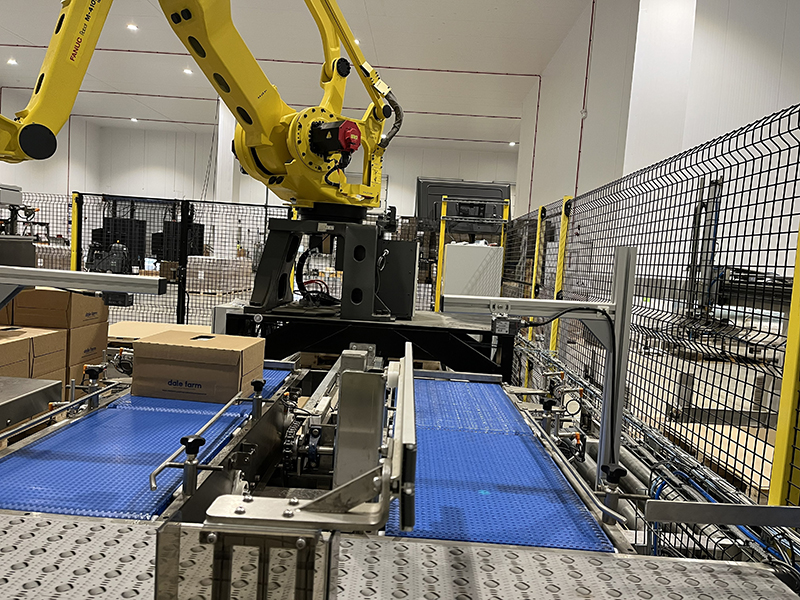
“The issue with palletising cheese blocks traditionally is that they’re heavy, and it’s very repetitive work,” John said. “Lifting and dropping down from height is a problem for manual employees. It’s difficult for food producers to find labour for this kind of task, and retention is just as big a problem.”
John added, “Cheese is a product that really lends itself to automation, as automation is consistently reliable, offers full traceability and is highly efficient. This particular cell runs for 20hrs/day, followed by a cleaning cycle, for 355 days/year. By leaving the robot to do the repetitive, heavy, potentially dangerous jobs such as palletising, food producers such as Dale Farm Foods can divert their employees to carry out more value-added tasks.”