
NEW research has revealed the vast majority of European consumers are aware that some typical supermarket products feature recycled plastic in their packaging.
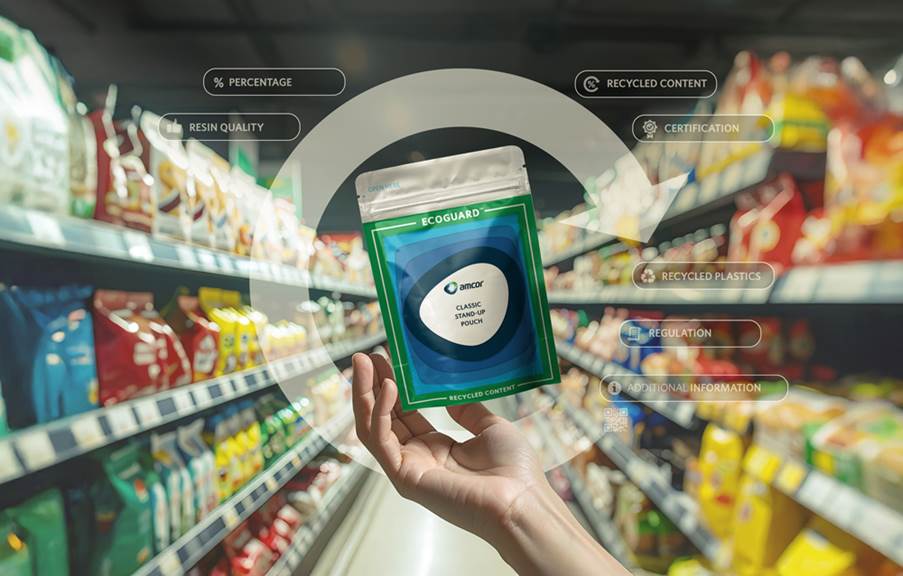
Amcor has released its latest consumer insight report, Recycled Content, Real Impact, exploring how shoppers perceive the use of post‑consumer recycled (PCR) content in packaging for supermarket products.
Drawing on insights from 3,201 consumers surveyed and 32 qualitative interviews across six major European countries, the research found that 91% of European consumers are aware that products such as food, beverage, pet food, cleaning, and beauty products contain recycled plastic in their packaging.
Significantly, this has translated into action, with 76% of European shoppers knowingly buying products that use recycled material in their packaging. A further 79% believe using recycled plastic in product packaging is an effective way to reduce environmental impact.
Amcor’s research highlighted that consumers, particularly younger age groups, positively view the use of recycled material in product packaging. 63% of European consumers say the use of recycled content increases their trust in a brand.
53% of consumers say the use of recycled plastic in packaging makes ‘no difference’ to how they view the quality of the product. And more than one in five (22%) say that using recycled plastic actually improves the quality of the packaging.
Amcor said positive attitudes towards the use of PCR plastics are largely linked to sustainability benefits, with reduced environmental impact cited most frequently (67%), as well as resource conservation (53%), lower carbon footprint (43%), and support for a circular economy (40%).
Despite this, consumers are wary of unfounded claims and seek verification about what is being said. 79% want to see independent certification of recycled material on packaging, while 58% want packaging to clearly show the percentage of recycled material used. As a result, Amcor added that clear messaging and verifiable sustainability claims are essential to help consumers understand the environmental impact of product packaging across all FMCG sectors.
Lead researcher on the project, Sarah Neerkorn, market insights manager, Amcor, said, “Consumers understand recycled material, and respond very positively to it. It’s clear how much consumers value third-party certification. Even though they may not understand what’s behind the certification, it gives them reassurance and adds to the credibility of the claim.”
Lucie Charbonnel, sustainability director for Amcor, added, “The European Union’s mandatory recycled plastic targets will come into play in 2030. While that may seem a way off, we strongly encourage brand owners to start integrating PCR into their packaging now. Beginning PCR use now, even if only for specific SKUs or geographies, will enable technical validation and help brands to set up traceability processes for certifications.
“Also, brand-owners can take advantage of financial incentives available today in some countries that reward the use of PCR, either through reduced plastic tax or bonuses within Extended Producer Responsibility (EPR) schemes.”